
Masutatsu Oyama
the founder of Kyokushin karate
Masutatsu Ōyama, born Hyung Yee Choi in Korea on July 27, 1923, is the founder of Kyokushin Karate. After relocating to Tokyo, he adopted the Japanese name Masutatsu Ōyama and dedicated his life to karate. In 1953, he established his first dojo on a grassy lot in Tokyo’s Meijiro district. Two years later, he opened a formal dojo in a former ballet school, which became the birthplace of Kyokushin Karate. In 1954, during a visit to Hawaii, Ōyama met Edward “Bobby” Lowe, a Kenpō expert whom he later regarded as a brother. Lowe had the honor of opening the first Kyokushin branch outside Japan. By 1957, despite the rigorous training, the dojo had over 700 students, and that year, the name “Kyokushin,” meaning “Ultimate Truth,” was officially adopted.

The Kanji
The Kanji emblem, universally worn on practitioners' dogi, signifies the pursuit of the ultimate truth in Kyokushin. The Kanku symbol, derived from the kata of the same name meaning "to view the sky," represents the Kyokushinkai style. The International Karate Organization (IKO) Nakamura's version of the Kanku incorporates a fist and a universal symbol at its center.
The Kanku
The Kanku is the emblem representing the Kyokushinkai Karate style. It originates from the kata of the same name, which translates to "contemplating the sky."

The WIKO
Lorem ipsum dolor sit amet consectetur adipisicing elit. Corporis illum nesciunt commodi vel nisi ut alias excepturi ipsum,

Kyokushin
Around the world
Kyokushin’s reputation grew, attracting students from various schools eager to learn Ōyama’s combat techniques, especially Jissen-Kumite. Full-contact sparring was integral to this training. Observing his fighters, Ōyama continually refined his karate by adding and perfecting techniques. The style soon earned the moniker “The Strongest Karate,” reflecting both Ōyama’s prowess and the demanding training regimen. Today, Kyokushin is one of the most practiced karate styles worldwide, with over 20 million practitioners. On April 26, 1994, Sosai Masutatsu Ōyama, 10th Dan, passed away from lung cancer at 70. A monument in his honor stands on Mount Mitsumine in Chichibu Tamakai Park, now a pilgrimage site for Kyokushin practitioners seeking spiritual inspiration. Many worldwide practitioners delve into Kyokushin’s philosophy, emphasizing self-improvement and discipline. The teaching focuses on self-control rather than overpowering opponents. Ōyama’s core philosophy advises against actions that cannot be undone and cautions against using excessive force. Currently, Kyokushin is the most practiced karate style globally, with over 20 million practitioners in 140 countries. Its popularity is bolstered by media exposure, including television features, films, comics, and numerous publications about Ōyama. Kyokushin’s appeal lies in its dynamic and realistic combat style, making it both physically demanding and highly effective.
The Dojo Kun
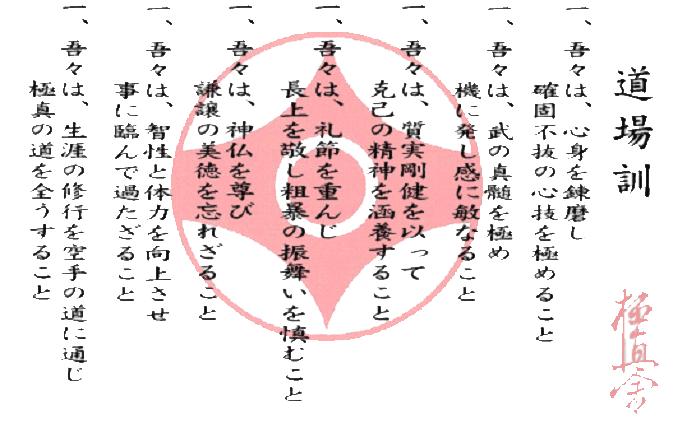
The Dojo Kun provides a clear path toward the ultimate goals of Kyokushin: character development, sincerity, constant effort, respect for others, and self-control. While technique is important, the primary focus is on disciplining the inner spirit. By adhering to these simple principles, karatekas begin to make progress on the path of Kyokushin Karate.
- We will train our hearts and bodies for a firm, unshaking spirit.
- We will pursue the true meaning of the Martial Way, so that in time, our senses may be alert.
- With true vigor, we will seek to cultivate a spirit of self-denial.
- We will observe the rules of courtesy, respect our superiors, and refrain from violence.
- We will follow our master and never forget the true virtue of humility.
- We will look upwards to wisdom and strength, not seeking other desires.
- All our lives, through the discipline
- This is the way of Kyokushin.